Search This Blog

Thursday, March 7, 2013

Giant Anaconda


Brazil Flora & Fauna News

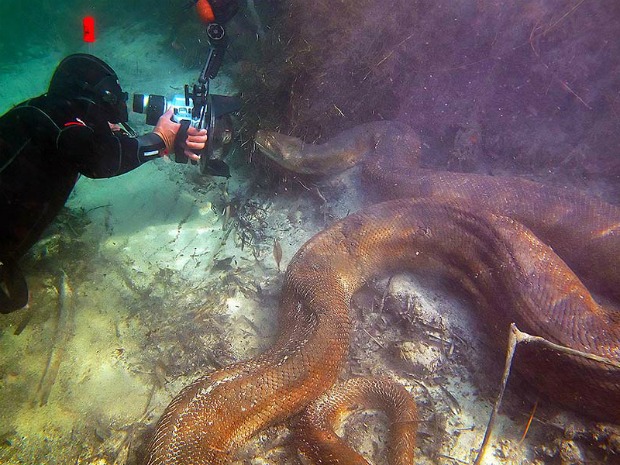
CAMPO GRANDE, Brazil – Images of a giant anaconda being photographed underwater created a stir this week on Facebook Brazil. After the amazing images were posted and shared, many Facebook users posted comments doubting the authenticity of the photographs.


A giant anaconda, estimated at about 23 feet in length, is photographed underwater by biologist Daniel De Granville in Bonito, Mato Grosso do Sul, Brazil

Giant Anaconda Underwater (Photo: Daniel De Granville/Natura/G1)


The biologist and the images of the giant serpent
Biologist Daniel De Granville, who took the pictures, assured the G1 network that the images of the huge reptile, which he estimated to be about seven meters (23 feet), are genuine and that he captured them in the Formoso River, in Bonito, 300 km (186 miles) from Campo Grande.


Video of Giant Anaconda Underwater (Photo: YouTube/w1tenminutes)
 
De Granville says that the photos are original and made in a natural environment without any digital manipulation beyond the basic settings for color, sharpness and saturation. The images were captured in August 2010 in a place away from the city’s tourist attractions and in an area restricted to most visitors.


The area where the giant green anaconda was spotted is restricted
According to the biologist, access to the area is restricted to researchers or film crews. De Granville says that the anaconda is a shy animal and tends to stay away from places where there is a constant human presence. “The possibility of finding an animal of this size in tours made by visitors who some to the region is very remote,” he told G1.
The Chinese, Czechs and Swiss
The images were made in the company of Chinese, Czech and Swiss photographers and the owner of a travel agency which specializes in underwater filming. “We found a place with more chances to see it and we were there several days. They got pictures of the animal out of water, but the main goal was the underwater shots,” said the biologist.
The giant green anaconda underwater
Also according to De Granville, the enormous serpent showed no aggression, and there were never any incidents or danger to the team. “It’s a very tolerant animal. We were filming for more than forty minutes.” If a tourist is faced with an anaconda, De Granville advises that the animal must be respected in its habitat. “It is vital not to block his escape route or to annoy it by trying to manipulate it with noise or nudges,” he said.
Tourism in Bonito, Mato Grosso do Sul
According to Wikipedia, Bonito, in the Brazilian state of Mato Grosso do Sul, is known as the “Caribbean of the Central-West” because of the unbelievable blue color of its waters. The government of the region promotes tourism in the area but also strictly controls the number of tourists allowed. These limitations are aimed at preserving the rich natural beauty of the area.

Believe, Conceive, Achieve


Believe, Conceive, Achieve


http://www.pravsworld.com/uploads/content/pictures/389/273/original.jpg


http://nataliaph.com/wp-content/uploads/2012/02/lios.jpg


http://blog.cheetahlearning.com/wp-content/uploads/2010/12/Believe-in-YourselfFINAL-300x200.jpg


https://blogger.googleusercontent.com/img/b/R29vZ2xl/AVvXsEgNtqaSc6MlYowIscfDJZ1lr8QJ_jd3Gi01VnnQs17QgGtwIPsuvcxAp4yHQ14KA-4ep9G3vpls1XxPIM_0RXsj4XS-gmgMNmIRzXlJ3H4xw68qHic695SMPQPTjt7vwvHIOk7Q9vCglcM/s1600/Believe-in-yourself.jpg


http://25.media.tumblr.com/tumblr_m7dabeudAS1rzqd3po1_500.png


http://www.radio-subterranean.com/atelier/creative_whack_pack/50.believe_in_yourself.jpg


http://www.canadianbaseballnetwork.com/wp-content/uploads/Believe-in-yourself-1-590x474.jpg

http://christinambove.com/wp-content/uploads/2012/09/ar1233789449136051.jpg


 http://garrisongs.files.wordpress.com/2012/03/believe-in-yourself.jpg?w=510&h=723

 http://www.empowernetwork.com/artariuz/files/2012/12/believe-in-yourself.jpg


G

Tuesday, March 5, 2013


"Nothing in the world can take the place of persistence...Persistence and determination alone are omnipotent."
- Calvin Coolidge


But human experience is usually paradoxical, that means incongruous with the phrases of current talk or even current philosophy.
- George Eliot

"Yesterday's failures are today's seeds that must be diligently planted to be able to abundantly harvest tomorrow's successes."
- Author Unknown  
 In speaking of the Energy of the field, however, I wish to be understood literally. All energy is the same as mechanical energy, whether it exists in the form of motion or in that of elasticity, or in any other form. The energy in electromagnetic phenomena is mechanical energy.
- James Clerk Maxwell

Quotes: Frank Lloyd Wright


A professional is one who does his best work when he feels the least like working.
- Frank Lloyd Wright


An idea is salvation by imagination.
- Frank Lloyd Wright


The thing always happens that you really believe in; and the belief in a thing makes it happen.
- Frank Lloyd Wright


The truth is more important than the facts.
- Frank Lloyd Wright


Tip the world over on its side and everything loose will land in Los Angeles.
- Frank Lloyd Wright


Form follows function-that has been misunderstood. Form and function should be one, joined in a spiritual union.
- Frank Lloyd Wright, 1908


The architect should strive continually to simplify; the ensemble of the rooms should then be carefully considered that comfort and utility may go hand in hand with beauty.
- Frank Lloyd Wright, 1908


The physician can bury his mistakes, but the architect can only advise his client to plant vines - so they should go as far as possible from home to build their first buildings.
- Frank Lloyd Wright, New York Times, October 4, 1953


Give me the luxuries of life and I will willingly do without the necessities.
- Frank Lloyd Wright, quoted in his obituary, April 9, 1959


Noble life demands a noble architecture for noble uses of noble men.  Lack of culture means what it has always meant: ignoble civilization and therefore imminent downfall.
- Frank Lloyd Wright (1869 - 1959)


Television: chewing gum for the eyes.
- Frank Lloyd Wright (1869 - 1959)


The longer I live the more beautiful life becomes.
- Frank Lloyd Wright (1869 - 1959)


I believe in God, only I spell it Nature.
- Frank Lloyd Wright (1869 - 1959)


Freedom is from within.
- Frank Lloyd Wright (1869 - 1959)


Monday, March 4, 2013

The Strangest Secret

 This is a partial transcript...

The Strangest Secret


Some years ago, the late Nobel prize-winning Dr. Albert Schweitzer was asked by a reporter, "Doctor, what's wrong with men today?" The great doctor was silent a moment, and then he said, "Men simply don't think!"

It's about this that I want to talk with you. We live today in a golden age. This is an era that humanity has looked forward to, dreamed of, and worked toward for thousands of years. We live in the richest era that ever existed on the face of the earth ... a land of abundant opportunity for everyone.

However, if you take 100 individuals who start even at the age of 25, do you have any idea what will happen to those men and women by the time they're 65? These 100 people believe they're going to be successful. They are eager toward life, there is a certain sparkle in their eye, an erectness to their carriage, and life seems like a pretty interesting adventure to them.

But by the time they're 65, only one will be rich, four will be financially independent, five will still be working, and 54 will be broke — depending on others for life's necessities.

Only five out of 100 make the grade! Why do so many fail? What has happened to the sparkle that was there when they were 25? What has become of the dreams, the hopes, the plans ... and why is there such a large disparity between what these people intended to do and what they actually accomplished?


THE DEFINITION OF SUCCESS 


First, we have to define success and here is the best definition I've ever been able to find: "Success is the progressive realization of a worthy ideal."

A success is the school teacher who is teaching because that's what he or she wants to do. A success is the entrepreneur who start his own company because that was his dream — that's what he wanted to do. A success is the salesperson who wants to become the best salesperson in his or her company and sets forth on the pursuit of that goal.

A success is anyone who is realizing a worthy predetermined ideal, because that's what he or she decided to do ... deliberately. But only one out of 20 does that! The rest are "failures."

Rollo May, the distinguished psychiatrist, wrote a wonderful book called Man's Search for Himself, and in this book he says: "The opposite of courage in our society is not cowardice ... it is conformity." And there you have the reason for so many failures. Conformity — people acting like everyone else, without knowing why or where they are going.

We learn to read by the time we're seven. We learn to make a living by the time we're 30. Often by that time we're not only making a living, we're supporting a family. And yet by the time we're 65, we haven't learned how to become financially independent in the richest land that has ever been known. Why? We conform! Most of us are acting like the wrong percentage group — the 95 who don't succeed.


GOALS


Have you ever wondered why so many people work so hard and honestly without ever achieving anything in particular, and why others don't seem to work hard, yet seem to get everything? They seem to have the "magic touch." You've heard people say, "Everything he touches turns to gold." Have you ever noticed that a person who becomes successful tends to continue to become more successful? And, on the other hand, have you noticed how someone who's a failure tends to continue to fail?

The difference is goals. People with goals succeed because they know where they're going. It's that simple. Failures, on the other hand, believe that their lives are shaped by circumstances ... by things that happen to them ... by exterior forces.

Think of a ship with the complete voyage mapped out and planned. The captain and crew know exactly where the ship is going and how long it will take — it has a definite goal. And 9,999 times out of 10,000, it will get there.

Now let's take another ship — just like the first — only let's not put a crew on it, or a captain at the helm. Let's give it no aiming point, no goal, and no destination. We just start the engines and let it go. I think you'll agree that if it gets out of the harbor at all, it will either sink or wind up on some deserted beach — a derelict. It can't go anyplace because it has no destination and no guidance.

It's the same with a human being. However, the human race is fixed, not to prevent the strong from winning, but to prevent the weak from losing. Society today can be likened to a convoy in time of war. The entire society is slowed down to protect its weakest link, just as the naval convoy has to go at the speed that will permit its slowest vessel to remain in formation.

That's why it's so easy to make a living today. It takes no particular brains or talent to make a living and support a family today. We have a plateau of so-called "security." So, to succeed, all we must do is decide how high above this plateau we want to aim.

Throughout history, the great wise men and teachers, philosophers, and prophets have disagreed with one another on many different things. It is only on this one point that they are in complete and unanimous agreement — the key to success and the key to failure is this:


WE BECOME WHAT WE THINK ABOUT


This is The Strangest Secret! Now, why do I say it's strange, and why do I call it a secret? Actually, it isn't a secret at all. It was first promulgated by some of the earliest wise men, and it appears again and again throughout the Bible. But very few people have learned it or understand it. That's why it's strange, and why for some equally strange reason it virtually remains a secret.

Marcus Aurelius, the great Roman Emperor, said: "A man's life is what his thoughts make of it."

Disraeli said this: "Everything comes if a man will only wait ... a human being with a settled purpose must accomplish it, and nothing can resist a will that will stake even existence for its fulfillment."

William James said: "We need only in cold blood act as if the thing in question were real, and it will become infallibly real by growing into such a connection with our life that it will become real. It will become so knit with habit and emotion that our interests in it will be those which characterize belief." He continues, " ... only you must, then, really wish these things, and wish them exclusively, and not wish at the same time a hundred other incompatible things just as strongly."

My old friend Dr. Norman Vincent Peale put it this way: "If you think in negative terms, you will get negative results. If you think in positive terms, you will achieve positive results." George Bernard Shaw said: "People are always blaming their circumstances for what they are. I don't believe in circumstances. The people who get on in this world are the people who get up and look for the circumstances they want, and if they can't find them, make them."

Well, it's pretty apparent, isn't it? We become what we think about. A person who is thinking about a concrete and worthwhile goal is going to reach it, because that's what he's thinking about. Conversely, the person who has no goal, who doesn't know where he's going, and whose thoughts must therefore be thoughts of confusion, anxiety, fear, and worry will thereby create a life of frustration, fear, anxiety and worry. And if he thinks about nothing ... he becomes nothing.


AS YE SOW — SO SHALL YE REAP

The human mind is much like a farmer's land. The land gives the farmer a choice. He may plant in that land whatever he chooses. The land doesn't care what is planted. It's up to the farmer to make the decision. The mind, like the land, will return what you plant, but it doesn't care what you plant. If the farmer plants too seeds — one a seed of corn, the other nightshade, a deadly poison, waters and takes care of the land, what will happen?

Remember, the land doesn't care. It will return poison in just as wonderful abundance as it will corn. So up come the two plants — one corn, one poison as it's written in the Bible, "As ye sow, so shall ye reap."

The human mind is far more fertile, far more incredible and mysterious than the land, but it works the same way. It doesn't care what we plant ... success ... or failure. A concrete, worthwhile goal ... or confusion, misunderstanding, fear, anxiety, and so on. But what we plant it must return to us.

The problem is that our mind comes as standard equipment at birth. It's free. And things that are given to us for nothing, we place little value on. Things that we pay money for, we value.

The paradox is that exactly the reverse is true. Everything that's really worthwhile in life came to us free — our minds, our souls, our bodies, our hopes, our dreams, our ambitions, our intelligence, our love of family and children and friends and country. All these priceless possessions are free.

But the things that cost us money are actually very cheap and can be replaced at any time. A good man can be completely wiped out and make another fortune. He can do that several times. Even if our home burns down, we can rebuild it. But the things we got for nothing, we can never replace.

Our mind can do any kind of job we assign to it, but generally speaking, we use it for little jobs instead of big ones. So decide now. What is it you want? Plant your goal in your mind. It's the most important decision you'll ever make in your entire life.

Do you want to excel at your particular job? Do you want to go places in your company ... in your community? Do you want to get rich? All you have got to do is plant that seed in your mind, care for it, work steadily toward your goal, and it will become a reality.
It not only will, there's no way that it cannot. You see, that's a law — like the laws of Sir Isaac Newton, the laws of gravity. If you get on top of a building and jump off, you'll always go down — you'll never go up.

And it's the same with all the other laws of nature. They always work. They're inflexible. Think about your goal in a relaxed, positive way. Picture yourself in your mind's eye as having already achieved this goal. See yourself doing the things you will be doing when you have reached your goal.

Every one of us is the sum total of our own thoughts. We are where we are because that's exactly where we really want or feel we deserve to be — whether we'll admit that or not. Each of us must live off the fruit of our thoughts in the future, because what you think today and tomorrow — next month and next year — will mold your life and determine your future. You're guided by your mind.

I remember one time I was driving through e a s t e r n Arizona and I saw one of those giant earth moving machines roaring along the road with what looked like 30 tons of dirt in it — a tremendous, incredible machine — and there was a little man perched way up on top with the wheel in his hands, guiding it. As I drove along I was struck by the similarity of that machine to the human mind. Just suppose you're sitting at the controls of such a vast source of energy.

 Are you going to sit back and fold your arms and let it run itself into a ditch? Or are you going to keep both hands firmly on the wheel and control and direct this power to a specific, worthwhile purpose? It's up to you. You're in the driver's seat. You see, the very law that gives us success is a doubleedged sword. We must control our thinking. The same rule that can lead people to lives of success, wealth, happiness, and all the things they ever dreamed of — that very same law can lead them into the gutter. It's all in how they use it ... for good or for bad.

That is The Strangest Secret!


Do what the experts since the dawn of recorded history have told us to do: pay the price, by becoming the person you want to become. It's not nearly as difficult as living unsuccessfully.

The moment you decide on a goal to work toward, you're immediately a successful person — you are then in that rare group of people who know where they're going. Out of every hundred people, you belong to the top five. Don't concern yourself too much with how you are going to achieve your goal — leave that completely to a power greater than yourself. All you have to do is know where you're going. The answers will come to you of their own accord, and at the right time.


Start today. You have nothing to lose — but you have your whole life to win.


30-DAYACTION IDEAS FOR PUTTING THE STRANGEST SECRET TO WORK FOR YOU

For the next 30-days follow each of these steps every day until you have achieved your goal.

1. Write on a card what it is you want more that anything else. It may be more money. Perhaps you'd like to double your income or make a specific amount of money. It may be a beautiful home. It may be success at your job. It may be a particular position in life. It could be a more harmonious family.


Write down on your card specifically what it is you want. Make sure it's a single goal and clearly defined. You needn't show it to anyone, but carry it with you so that you can look at it several times a day. Think about it in a cheerful, relaxed, positive way each morning when you get up, and immediately you have something to work for — something to get out of bed for, something to live for.


Look at it every chance you get during the day and just before going to bed at night. As you look at it, remember that you must become what you think about, and since you're thinking about your goal, you realize that soon it will be yours. In fact, it's really yours the moment you write it down and begin to think about it.


2. Stop thinking about what it is you fear. Each time a fearful or negative thought comes into your mind, replace it with a mental picture of your positive and worthwhile goal. And there will come a time when you'll feel like giving up. It's easier for a human being to think negatively than positively. That's why only five percent are successful! You must begin now to place yourself in that group.


"Act as though it were impossible to fail," as Dorothea Brande said. No matter what your goal — if you've kept your goal before you every day — you'll wonder and marvel at this new life you've found.


3. Your success will always be measured by the quality and quantity of service you render. 


Most people will tell you that they want to make money, without understanding this law. The only people who make money work in a mint. The rest of us must earn money. This is what causes those who keep looking for something for nothing, or a free ride, to fail in life. Success is not the result of making money; earning money is the result of success — and success is in direct proportion to our service.

Most people have this law backwards. It's like the man who stands in front of the stove and says to it: "Give me heat and then I'll add the wood." How many men and women do you know, or do you suppose there are today, who take the same attitude toward life? There are millions.


We've got to put the fuel in before we can expect heat. Likewise, we've got to be of service first before we can expect money. Don't concern yourself with the money. Be of service ... build ... work ... dream ... create! Do this and you'll find there is no limit to the prosperity and abundance that will come to you.

Don't start your test until you've made up your mind to stick with it. If you should fail during your first 30 days — by that I mean suddenly find yourself overwhelmed by negative thoughts — simply start over again from that point and go 30 more days. Gradually, your new habit will form, until you find yourself one of that wonderful minority to whom virtually nothing is impossible.

Above all ... don't worry! Worry brings fear, and fear is crippling. The only thing that can cause you to worry during your test is trying to do it all yourself. Know that all you have to do is hold your goal before you; everything else will take care of itself.


Take this 30-day test, then repeat it ... then repeat it again. Each time it will become more a part of you until you'll wonder how you could have ever have lived any other way. Live this new way and the floodgates of abundance will open and pour over you more riches than you may have dreamed existed. Money? Yes, lots of it. But what's more important, you'll have peace ... you'll be in that wonderful minority who lead calm, cheerful, successful lives.


Learn more about Earl Nightingale and his many timeless books and audio programs.

The Strangest Secret - Advantedge Article By Earl Nightingale

LINK:  http://www.nightingale.com/ae_article~i~22~article~strangestsecret.aspx


The Strangest Secret Earl Nightingale Conant 1950's Origional FULL 31:35 Min.

31:35 - 4 years ago

Earl Nightingale Conant The Strangest Secret 1956 1950's


Saturday, March 2, 2013

Things Stephen Covey Taught Us


Two Things From Stephen Covey 


Book:   Spiritual Roots of Human Relations.

Needless to say, a much younger version of the Stephen Covey most people are familiar with. Since that time, like many, I’ve read one or two of his more recognized 7 Habits books. However, it was this first book that formed my opinions of him.

I must admit I hadn’t picked up that book in a while, until I pulled it off my bookshelf Tuesday morning upon hearing of his passing.

Although it’s not a business book, his views regarding the root of what plagues business and politics still resonate with me:


Stephen Covey: 10 Quotes That Can Change Your Life Kevin Kruse Contributor

“The roots of the problems we face in the world, in our national life, and in our family and personal lives are spiritual. The symptom manifestations (leaves) of these problems are social, economic, and political. But the roots are moral and spiritual. And they lie first within each individual and then within the family.”

Regardless of the business you are in or your particular faith or philosophical opinion, the spiritual nature of how we interact with people is relevant. What’s more, the implications of amoral leadership and interpersonal relationships plague the way we do business, the way our governments function and are regularly reported in the news (as too many CEOs and political leaders slink off into the corner in disgrace).

However, I have found Dr. Covey’s insight to be most relevant in how I interact with people one on one.

In fact, there are two principles he espoused that have stayed with me. I wish I could remember which book or speech they came from, but I don’t think it matters—they are two things I learned from Dr. Covey that I try to remember as I have been tasked to lead people and projects.

People are not resources like computers or office furniture: Over the years I’ve come to dislike referring to people as resources (although I have yet to come up with a more elegant alternative). I just don’t like the dispassionate nature of the term Human Resources.

In business we manage process, but we lead people. Business school does a great job of teaching people how to manage, but if my experience over the last 30 or so years is any indication (and I don’t think I’m that unique), I’ve had damn few leaders. Business is personal.

The way we interact with our colleagues, the way we interact with our superiors and subordinates is very personal—at least it should be. If we look at the metrics they drive as the only measure of whether or not someone is making a meaningful contribution to our organizations, we are only looking at part of the picture.

Of course, performance metrics are important, but I’ve noticed that dogmatically focusing on the end result, rather than the root (as Dr. Covey might suggest), might not achieve that desired end result anyway.

Business is personal and people are not resources—they are people.

Techniques fall flat, a genuine interest in other’s success creates successful organizations: All you need to do is peruse the local bookstore or visit Amazon.com to learn the latest and greatest business management techniques.

I spend a lot of time reading them myself—however, if they merely become techniques to manipulate (or manage) people, your colleagues will see right through you.

Because business is personal, a genuine interest in the people you work with and a desire to help those you lead achieve success is what really drives business performance. 

What’s more, honesty and integrity are not techniques—they should be the way we are, the way we do business and the way we interact with people.

This type of atmosphere is created from the top.   A “Do what I say and not what I do” approach to how you manage your business does not work.

However, there is hope for those of us less inclined to interact genuinely with people.

Jean Kerr said, “Man is the only animal that learns by being hypocritical. He pretends to be polite and then, eventually, he becomes polite.” 

I think this is true of developing a genuine interest in our relationships with colleagues as well (for those of you who feel you might be lacking).

“As with physical exercise,” writes Dr. Covey, “those of us who say we haven’t the time for ‘spiritual aerobics’ are excuse making and will find ourselves, whenever the situation calls for strength beyond our reserve, incapacitated by self doubt, envy, jealousy, pride, fear, anger, bad tempers, all indicating a lack of spiritual oxygen.”


Source:

Two Things I Learned From Stephen Covey - Forbes

http://www.forbes.com/sites/tykiisel/2012/07/18/two-things-i-learned-from-steven-covey/


Robert Burton Quotes


Robert Burton Quotes

Old friends become bitter enemies on a sudden for toys and small offenses.
Robert Burton
Small, Friends, Old

To enlarge or illustrate this power and effect of love is to set a candle in the sun.
Robert Burton
Love, Sun, Candle

A blow with a word strikes deeper than a blow with a sword.
Robert Burton
Word, Sword, Blow

A dwarf standing on the shoulders of a giant may see farther than a giant himself.
Robert Burton
May, Himself, Standing

A good conscience is a continual feast.
Robert Burton
Conscience, Feast, Continual

A quiet mind cureth all.
Robert Burton
Mind, Quiet

Almost in every kingdom the most ancient families have been at first princes' bastards.
Robert Burton
Almost, Families, Bastards

Every man hath a good and a bad angel attending on him in particular all his life long.
Robert Burton
Bad, Him, Long

Great feelings will often take the aspect of error, and great faith the aspect of illusion.
Robert Burton
Feelings, Faith, Often

Idleness is an appendix to nobility.
Robert Burton
Idleness, Nobility

Like dogs in a wheel, birds in a cage, or squirrels in a chain, ambitious men still climb and climb,with great labor, and incessant anxiety, but never reach the top.
Robert Burton
Men, Still, Anxiety

No cord or cable can draw so forcibly, or bind so fast, as love can do with a single thread.
Robert Burton
Single, Fast, Draw

No rule is so general, which admits not some exception.
Robert Burton
General, Rule, Exception

One was never married, and that's his hell; another is, and that's his plague.
Robert Burton
Marriage, Hell, Another

The men who succeed are the efficient few. They are the few who have the ambition and will power to develop themselves.
Robert Burton
Power, Men, Ambition

We can make mayors and officers every year, but not scholars.
Robert Burton
Year, Officers, Scholars

What is life, when wanting love? Night without a morning; love's the cloudless summer sun, nature gay adorning.
Robert Burton
Morning, Without, Gay

Worldly wealth is the Devil's bait; and those whose minds feed upon riches recede, in general, from real happiness, in proportion as their stores increase, as the moon, when she is fullest, is farthest from the sun.
Robert Burton
Happiness, Real, Sun


Biography
Nationality: English
Type: Writer
Born: February 8, 1577
Died: January 25, 1640


Source:
Read more at http://www.brainyquote.com/quotes/authors/r/robert_burton.html#hGv5sJkSxgMZHtlG.99


\Maria Fowler overshares on Twitter as she posts picture in just a thong | Mail Online

Monasteries

 "However many holy words you read, however many you speak, what good will they do you If you do not act on upon them?"

BUDDHA


Buddhist monasteries are usually located in remote places far from the hub-bub of cities and towns. It takes more than a mild determination to reach them, but some of these are decidedly inaccessible. The idea is to keep all but only the most dedicated followers from reaching these holy places, while they also make the monks feel like they were closer to God in a place of peace and solitude. Today, however, most of these monasteries are tourist attractions and in favor of the tourists, several accessible methods like ropeways and stairs have been added. They still look formidable and requires hundreds of meters of vertical trekking. You better have a good pair of legs if you plan on visiting one of these.

Monasteries of Meteora, Greece

The Metéora (Greek for "suspended in the air" or "in the heavens above") is a group of six monasteries and one of the largest and most important complexes of Eastern Orthodox monasteries in Greece. The six monasteries, built on natural sandstone rock pillars, are one of the most powerful examples of the architectural transformation of a site into a place of retreat, meditation and prayer.


meteora-monastery-1


The monasteries are built on rock pinnacles of deltaic origin, known as Meteora, which rise starkly over 400 m above the Peneas valley and the small town of Kalambaka on the Thessalian plain. During the fearsome time of political instability in 14th century the monasteries were systematically built on top of the inaccessible peaks so that by the end of the 15th century there were 24 of them. They continued to flourish until the 17th century. Today, only four monasteries - Aghios Stephanos, Aghia Trias, Varlaam and Meteoron - still house religious communities.

Access to the monasteries was originally and deliberately difficult, requiring either long ladders lashed together or large nets used to haul up both goods and people. This required quite a leap of faith – the ropes were replaced, so the story goes, only "when the Lord let them break". In the 1920s there was an improvement in the arrangements. Steps were cut into the rock, making the complex accessible via a bridge from the nearby plateau.


meteora-monastery-2

meteora-monastery-5

meteora-monastery-4

meteora-monastery-0


Taung Kalat Monastery, Burma

The monastery of Taung Kalat is located on a top of a volcanic plug that rises 737 meters from the surrounding in central Burma (Myanmar) about 50 km southeast of Bagan, and near the extinct volcano Mount Popa. The monastery can be accessed by exactly 777 steps and those who reach the top are rewarded by a spectacular view.

To the north-west opens a view to distant temples of Bagan, and to the east is towering the forested Taung Ma-gyi summit. There is a big caldera, 610 metres wide and 914 metres in depth so that from different directions the mountain takes different forms with more than one peak. Many Macaque monkeys live here that have become a tourist attraction on Taung Kalat


Taungkalat-0 


Taungkalat-1


Taktsang Palphug Monastery, Bhutan

Taktshang monastery, also known as The Tiger's Nest, is located on a precipitous cliff about 900 metres above the Paro valley, in Bhutan. The rock slopes are very steep - almost vertical - and the monastery buildings are built into the rock face. Though it looks formidable, the monastery complex has access from several directions, such as the northwest path through the forest, from the south along the path used by devotees, and from the north. A mule track leading to it passes through pine forest that is colourfully festooned with moss and prayer flags. On many days, clouds shroud the monastery and give an eerie feeling of remoteness.


taktshang-3

taktshang-0

taktshang-2

Sümela Monastery

The Sumela Monastery is built into the rock cliffs of the Altmdere Valley in Turkey. At an altitude of about 1,200 metres it is a major tourist attraction of Altındere National Park.
The monastery was founded in 386 AD during the reign of the Emperor Theodosius I (375 - 395). Legend has it that two priests undertook its creation after discovering a miraculous icon of the Virgin Mary in a cave on the mountain. During its long history, the monastery fell into ruin several times and was restored by various emperors. It reached its present form in the 13th century after gaining prominence during the reign of Alexios III.

The monastery was abandoned after World War I and the start of the population exchanges between Greece and Turkey that forced some 2 million ethnic Greeks and Turks to leave their long-established communities in Turkey or Greece and return to their ethnic homelands. It lay empty for decades before being partially restored and returned to life as a museum.


sumela-0

sumela-1

sumela-2

Hanging Monastery, China

The Hanging Monastery or Hanging Temple is located in a canyon at the foot of the Mountain Heng in the province of Shanxi, China. The temple is built into the cliff side about 75 meter above the ground, and stands propped up by hidden rocks corridor and wooden beams inserted into the mountain. Over 40 halls, cabinets and pavilions within an area of 152.5 square meters are connected each other by corridors, bridges and boardwalks. They are evenly distributed and well balanced in height. Inside the temple are more than 80 bronze cast statues, iron cast statues, and clay sculptured statues and stone carvings banded down from different dynasties.

The temple was build to avoid the terrible flood, and use the mountain as protection from rain, snow and sunshine. Today, it is one of the main tourist attractions and historical sites in the Datong area.


hanging-temple-22

hanging-temple-16


“Flame Retardants” in Your Gatorade: Hazard, or Hype?


David L. Katz MD, MPH, FACPM, FACP is a board certified specialist in both Internal Medicine, and Preventive Medicine/Public Health. He is the founding Director (1998) of Yale University’s Prevention Research Center; Director and founder of the Integrative Medicine Center at Griffin Hospital (2000) in Derby, CT; founder and president of the non-profit Turn the Tide Foundation

 
bvoblog

“Flame Retardants” in Your Gatorade: Hazard, or Hype?

We have a long history of doing questionable things to vegetable oils — and putting them in odd places in the food supply.

The best-known and deservedly most notorious example to date is partial hydrogenation. Partially hydrogenated vegetable oils are formed when normally unsaturated oils are bombarded with hydrogen so that some but not all of those available bonds are “saturated” with it.

The result is trans fat, which we now know to be, in essence, a slow poison, contributing to the risk of heart disease in particular. Partially hydrogenated oils became widespread in the food supply because they are inexpensive to make and act much like saturated fats, providing stability and heat tolerance. With time, we have come to learn that partially hydrogenated oils lengthen the shelf life of foods but are apt to shorten the shelf lives of people eating the food. They are still out there, but have gone from nearly ubiquitous to increasingly rare. Good riddance to them.

Is brominated vegetable oil (BVO) the new trans fat? No.

Trans fat has long been used in many products with a significant amount of oil in the mix.

Exposure to trans fat has come in amounts of hundreds of milligrams, and even grams.

Paracelsus, considered the father of toxicology, famously told us “the dose makes the poison.”

Our exposure to trans fat was, and still is, at dose levels clearly linked to bad health outcomes.


In contrast, BVO is used in fruit-flavored soft drinks in amounts so tiny it often need not even be listed among the ingredients. BVO is measured in parts per million rather than grams or milligrams.

Bromine is used to increase the weight of the oil so it doesn’t rise to the top, and the oil then serves to keep fat-soluble citrus flavors in suspension. The result is probably an enhancement of the appearance of the drink and perhaps the taste.

BVO has been used in the making of soft drinks in the U.S. since the 1930s.

It received the designation “generally recognized as safe” from the U.S. FDA in 1958, but this was revised in 1970, at which time restrictions were placed on the amount that can be used in food.

The ingredient is now found in a variety of citrus-flavored beverages, including but not limited to Gatorade, Mountain Dew, Powerade, Fanta and Fresca.


BVO is in the news because it has been “called out” as an ingredient in a flame retardant after a young girl noted it on the Gatorade ingredient list, and did some investigating. 

It’s true that BVO can be used in a flame retardant, but I’m not sure it’s all that relevant. 

Elements that are an essential part of the human body can be mixed in some pretty toxic combinations as well. Some of what we are made of can be used to make pesticides and insecticides and other poisons, all depending on doses and what else is in the mix.


Is BVO dangerous? 

Possibly. Reviewing the relevant literature, I did find one case of harm linked to bromine in soft drinks, reported in 1997. A man consuming 2 to 4 liters a day of citrus-flavored soft drinks developed a neurological condition due to bromine excess. He was eventually diagnosed and treated, and he recovered.

I could find no other evidence of documented harm in people, although that of course does not rule it out. 

But since the ingredient has been in our beverages for nearly 100 years, we’ve had plenty of time to see harmful effects if they were occurring at a meaningful level. If they are occurring, they are subtle enough to fly mostly under the radar.

Since much of the focus has been on Gatorade, which is taking BVO out of its mix, I checked on the overall composition of their original “Perform” series drink. 


In 12 ounces, it has 80 calories, 160 milligrams of sodium and 21 grams of sugar. I really don’t think we need BVO in this mix to raise concerns about it.  And that, frankly, is where I land.

 Animal studies suggest some possibility of harm from BVO. Bromine toxicity is known to occur in people, generally resulting from medications that contain bromine in much higher concentrations than soft drinks. So the case can be made for “why take a chance?” If we can get rid of the BVO, we might as well.

But while any harms of BVO are speculative, the public health toll of excess calories and sugar is well established. The question for the teenage girl concerned enough about ingredients to investigate BVO is: why was she drinking a sugar-sweetened beverage in the first place? There is no BVO added to water.

I have long noted that we distort risks — trivializing those we feel we can control (such as our sugar intake, or driving too fast, or texting while driving) and exaggerating those we feel we cannot (such as BVO).
 

If you are really drinking enough of the sugared or artificially sweetened citrus-flavored beverages in question to be at any genuine risk of harm from BVO, then my view is: You’ve got bigger, far better-documented things to worry about!


Source:
 http://blog.sharecare.com/2013/01/30/flame-retardants-in-your-gatorade-hazard-or-hype/

“Flame Retardants” in Your Gatorade: Hazard, or Hype? « Sharecare.com Blog


Friday, March 1, 2013

Personal Mission Statement

Importance of Having a Personal Vision


Numerous experts on leadership and personal development emphasize how vital it is for you to craft your own personal vision for your life. 

Experts point out:

- that a vision can help you succeed far beyond where you'd be without one. 

-that vision can propel you and inspire those around you to reach their own dreams. 

If you don't identify your vision, others will plan and direct your life for you. 


Senge defines vision as what you want to create of yourself and the world around you. 

What does your vision include? Making a vital change in an area such as health, technology, or the environment? Raising happy, well-adjusted children? Writing a book? Owning your own business? Living on a beach? Being very fit and healthy? Visiting every continent? Helping others with their spiritual development? What are you good at? What do you love to do? What aren't you good at now, but you'd like to be? All of these important questions are part of identifying your personal vision.

Use this Tool #1 to think through and start to craft your personal vision. It's adapted from many sources and should prompt you to think and dream. Find a place without distractions such as a quiet table at a restaurant. Answer as many of the questions as possible, and discuss your responses with someone you trust.
Personal Vision Tool #1
Things I Really Enjoy Doing  
What Brings Me Happiness/Joy
The Two Best Moments of My Past Week
Three Things I'd Do If I Won the Lottery
       
 Issues or Causes I Care Deeply About
 My Most Important Values (Circle)
Things I Can Do at the Good-to-Excellent Level
What I'd Like to Stop Doing or Do as Little as Possible
 
Having integrity
Serving/pleasing God
Being fit and healthy
Having a nice home and belongings
Leaving the world a better place
Having fun
Learning and improving myself
Making others' lives easier or more pleasant
Enjoying my family
Others? (Add)
 

Did any of these questions trigger some ideas about what you'd like to be doing with your life between now and 2015?

If so, keep thinking about the questions and your answers, and continue your personal research.


Source:

Creating or Revising Your Personal Vision (Tool #1).


WRITING A PERSONAL VISION STATEMENT
by Dr. Linda Phillips-Jones

Your personal vision is what you want to be, do, feel, think, own, associate with, and impact by some date in the future. 

We recommend that you identify your Personal Vision as a development strategy. We're providing some tools to help you identify and implement your personal vision.


It's now time to pull together your research and write a Personal Vision Statement. 

Your vision must be unique and appropriate for you, so we offer the following Personal Vision Statement only as an example:

I am more physically fit, long finished with my formal education, actively involved in self-directed learning, having fun every day, and making money doing work that I love.


Notice in this sample that the person included several areas of life (physical, intellectual, social, spiritual, emotional, and career). 


It's a picture of how the person sees themselves in the near future and is written in the present tense.

Use the following tool to synthesize what you've learned about yourself and to write your own statement.


Tool #2: Personal Vision Statement
1. Based on my personal research, these are the main things that motivate me/bring me joy and satisfaction:
2. My greatest strengths/abilities/traits/things I do best:
3. At least two things I can start doing/do more often that use my strengths and bring me joy:
4. This is my Personal Vision Statement for myself (in 50 words or less):


Talk about your findings and your Vision Statement with someone you trust. 

If necessary, make a second, better draft, but don't compromise your passion. 

Think big, and hold onto your excitement! 

Now you're ready to turn your Vision Statement into an action plan.